

I was guiding on Ben Lawers today, on the 1st of October 2026. There were so many beautiful autumnal details: scarlet waxcaps, cowberries and blaeberries, luminous Bog Asphodol leaves, red Tormintil leaves, rusty deer grass, Alpine Lady’s Mantle and Yarrow. Always remember to be observant of all the beautiful things at your feet! This blog shares some of the lovely mountain botany seen on my hillwalk today.
Yarrow – Achillea millefolium
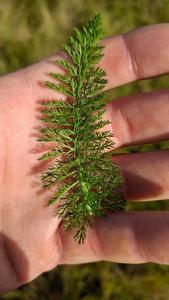
Yarrow flowers late in the summer and into Autumn. It has white and sometimes pink flowers. Its leaves are delicate, feathery and fern-like. The latin name for the plant is Achillea millefolium. Millefolium means a thousand leaves and the word Achillea means alchemy relating to the plant’s healing properties. The plant was known as the ‘soldier’s woundwort’ because of its potential to stem bleeding. It is also antiseptic, reduces inflammation and was used to reduce fevers.
Alpine Ladys Mantle – Achillea alpina

Alpine Lady’s Mantle is another medicinal plant. Like Yarrow it is an astringent, helping to stem the flow of blood. It was also used to sooth skin irritation and used for mild diarrhea. It’s said that alchemists, searching for a formula for creation of gold, would collect dew from the petals of Alpine Lady’s Mantle and add it to their recipe.
Deer Grass – Trichophorum cespitosum
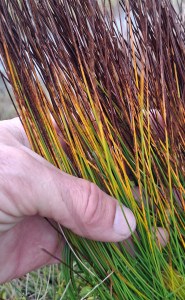
Deer grass isn’t a grass, it’s a sedge. During the summer it’s green but in the Autumn it turns a wonderful rusty red colour. Whole hillsides can take on a rusty colour because of this plant. Trichophorum means hairy and espitosum means clumpy.
Scarlet Waxcap – Hygrocybe coccinea
A Scarlet waxcap is a really beautiful mushroom with delicate gills, a waxy /slimy cap and red scarlet colour. Hygrocybe means wet or moist (describing the sliminess of the cap) and coccinea means bright red. Waxcap come in lots of different colours. Yellow ones are called Meadow Waxcaps, green ones are called Parrot Waxcaps and pink ones are called Ballerina Waxcaps.
Bog Asphodel – Narthecium ossifragum
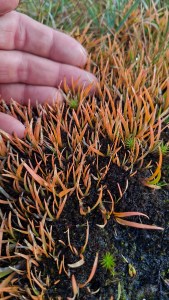

Bog Asphodel is a flower with yellow petals and, in the summer, fairly ordinary, unremarkable green, spear-like leaves. In the Autumn however the flower and leaves turn the most amazing luminous peachy orange colour. It’s one of my favourite things to see on the hill in Autumn. The latin name for the plant means ‘bone breaker’. Farmers believed that livestock grazing on the plant would develop weak brittle bones. In reality the plant grows in a nutrient poor habitat, and lacks calcium, hence the link to poor bone health.
Tormentil – Potentilla erecta
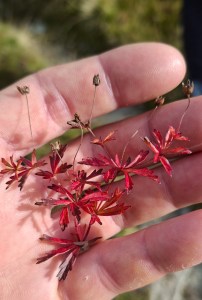
Tormentil are a common mountain plant with yellow flowers with four petals. Its leaves are palm-like, deeply divided and sharply toothed. In Autumn the leaves take on a brilliant red colour. They are a real joy to see. The latin name means upright and powerful. I think they are regarded as powerful because of their use in pain relief. Tormentil roots were used to treat the torment of illness, wounds and toothache.
Marsh Thistle – Cirsium palustre

Marsh thistles are one of three types of thistle I see quite regularly. The other ones are Spear Thistles and Creeping Thistle. Marsh thistles are distinctive in how tall they grow. By the end of summer they can be five feet tall. You typically see them on the open hill, on marshy ground. Palustre means marshy. Cirsium derives from the Greek work Kirsos which means veins. The plant was believed to be a remedy for swollen veins. At this time of year the plant is on is way out, decaying and drooping. The tall stem will have entirely disappeared by winter.
Blaeberry – Vaccinium myrtillus

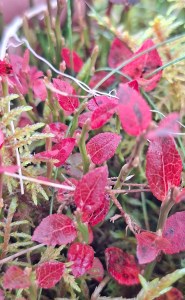
The Blaeberry is our Scottish blueberry. It is deciduous and its leaves, at this time of year, are turning a wonderful rich red colour, before falling off entirely in the winter. Its berries are edible and quite delicious, especially with sugar and made into jam, if you have the patience to collect enough of them. Vaccinium is a latin name for a dark berry and myrtillus means ‘little myrtle’.
If you’d like a day out on the hill to learn about mountain botany, Aspen run course upon request. An understanding mountain flora adds greatly to the enjoyment of a hillwalk.