
A blog by George Ewen….
Introduction
At the time of the Unstfest this summer, 2026, my wife Jean and I were on a walking tour of Shetland with Aspen Outdoors Ltd, an outdoors activities company run by our eldest son, Alastair Ewen. Our one day in Unst was mostly taken up by a visit to Hermaness, but we did have a brief stop at Halligarth, and we found an Edmondston’s chickweed at the Keen of Hamar..
T A Robertson, Vagaland, Shetland’s most famous poet, and his wife Pat, whom he married in 1953, spent several holidays in Unst, and I feel sure, given the content of his poem Halligarth, quoted below, that they paid a visit to the old house, and would have been welcomed by Stephen Saxby and his sister Lorna. Their father, Dr Thomas Saxby, had recently died in 1952, and their grandmother Jessie M E Saxby, whose literary works and influence Vagaland would have been keenly aware of, had died in her cottage Wuiiver’s Hool, nearby on the hillside, in 1940. Whilst Stephen and Lorna had not followed their close relations into medical, naturalist or literary distinction, I am sure that they would have proudly shown the Robertsons around the old house, with its many photographic portraits and images of family events. Many of these photograths are held now by the National Trust for Scotland, and were used as illustrations in Philip Snow’s excellent book, Tales from Wullver’s Hool. Whilst this is only my surmise, I feel that, though these images were largely in black and white, and some faded, they were enough to charge Vagaland’s mind to imagine the “colour and movement”, as referred to in the last couplet of the poem, that would have been evident in the house in its long heyday, with such an extended line of intellectual and creative luminaries, who had either resided or visited, within its walls and surrounding gardens and woods.
Halligarth by Vagaland
As flowers within a book pressed long ago,
-Ghosts of their former selves- will oft recall
The flush of Summer on Earth’s face, the glow
Of roses opening by a garden wall.
So this old house recalls another age
When candles, burning dimly in the gloom,
Cast their soft light upon a heritage
Of treasured things still seen in every room.
The portraits, as the dusk is deepening,
Their colours dimmed by Time, like long pressed flowers,
Are shadows in the shadows, but they bring
The past to us again, the pleasant hours.
Colour and movement- life from vanished days-
Unfold again before our dreaming gaze.
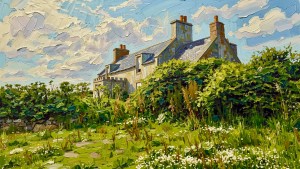
Thus I have put together this blog; from a variety of sources, information about the house and its inhabitants: and images, including from the Internet, Stories and Pictures of Unst Facebook group, and my own photographs. In order to convey something of the “colour and movement” that Vagaland would have felt, I have created, from these images, using several of my IPad art apps, paintings in an impasto style ( which means with thick, vivid and free strokes).
History
Halligarth is an important house, built on the site of a cottage in the laird’s estate of Buness, situated about half a kilometer north of Buness House, on the north shore of the sheltered harbour of Baltasound, on the east side of Unst, the most northerly inhabited island of Shetland.. It was the historic family home of the Edmondston and Saxby families.
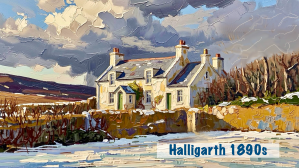


Halligarth is two complete stone built houses, one in front of the other, and joined by a very short linking passage. The back house was the first to be built in 1832 by Dr Laurence Edmondston. He had obtained a life rental of the property from his brother, the laird, at Buness House. With his wife Eliza and a growing family, they added a slightly larger house in front of the first one, in 1839. The east extension was built in 1860. Dr Edmondston was the doctor for the island of Unst till his retirement in 1862. He was also a renowned ornithologist.
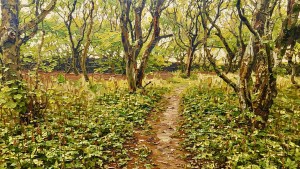
He is credited with the first spotting of the snowy owl in Unst in 1811, and he created a walled enclosure adjacent to Halligarth in which he planted and nurtured a small wood with a variety of trees, with the intent of creating a habitat, which would attract various bird species.
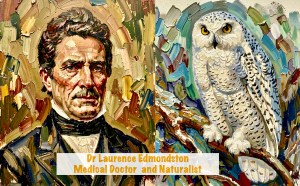

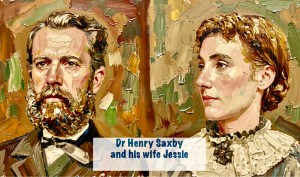
Notable within the 8 children who reached adulthood were Jessie M E Saxby (1842-1940), one of Shetland’s most gifted and prolific author-poets whose works explore Shetland folklore, language and the island’s Viking past. Among many published works was The Home of a Naturalist, written with her brother Biot, recounting life at Halligarth. Her first novel Rock-bound is currently available as a paperback in the series Northus Shetland Classics. She also wrote the lyrics for songs and edited the poems and reminiscences of Basil Anderson in the work entitled Broken Lights. Whilst living in Edinburgh Jessie benefited from friendship with Shetland antiquarian Gilbert Goudie, whose niece Jane Goudie, later married Jessie’s son Horace. Jane Saxby was herself a poet and lyrics writer, and was an important contributer to the origins of the Shetland Folk Society. Jessie’s husband Henry Saxby, was a doctor, an assistant to his father-in-law on Unst and later took on the practice after his father-in-law retired. Due to poor health Dr Saxby had to move away from Shetland to Argyll, where he died at a young age, but not before completing an important ornithological work entitled The Birds of Shetland, co-authored with his brother Stephen.

Dr Laurence Edmondston’s eldest son Thomas (1825-1846) was a remarkable prodigy, a talented botanist who was first to identify the unique chickweed, on the Keen of Hamar, now known as Edmondston’s chickweed. By the age of nineteen he had published The Flora of Shetland and became professor of botany at Anderson’s College, Glasgow. He was accidentally killed in an mishap with a firearm in 1846, during an expedition to Ecuador. Prior to sailing, Charles Darwin had corresponded with him for a list of specimens to collect from the Galapagos Islands.

Needless to say, Halligarth attracted notable visitors from both the scientific and artist communities. Even a nephew of Napoleon visited the house while studying the old Scandinavian-Shetland dialect. This environment of visiting intellectuals combined with the Edmondstons’ liberal approach to educating their large family, was significant in spreading the reputation of Halligarth to all of Scotland and beyond.
Halligarth as a Medical Centre
For the island of Unst, however, the medical services provided by the Edmondstons and Saxbys were of central significance. After Dr Laurence Edmonston retired in 1862, his son-in-law Dr Henry Saxby (Jessie’s husband} ran the practice solely, at first from Halligarth, but with the expansion of their family, they moved to a nearby property Ernesdaal in 1865. However, in 1871, due to Dr Saxby’s failing health, he, Jessie and family left Shetland, to live in Argyll, where he sadly died in 1873. Between 1871 and 1898 medical services in Unst were provided by others, and from Philip Snow’s book Tales From Wullver’s Hool we find that at least part of that period, the Unst doctor was by the name of Kennedy. When he moved away to a practice in Lybster Caithness, Jessie Saxby’s son Dr Thomas Saxby took over the practice in Unst, reestablishing Halligarth as the medical centre for the island.
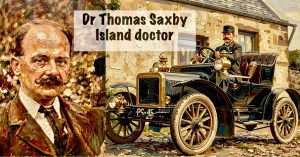
Jessie Saxby had returned to Unst in 1898 to live in her newly built house called Wullver’s Hool, situated nearby on the hillside overlooking Halligarth. In 1879 Dr Laurence Edmondston died, but his second wife Penelope remained at Halligarth till her death in 1888. Dr Edmondston’s grandson Laurence stayed on in Halligarth till 1898, when he moved to Buness House. This vacancy allowed Dr Thomas Saxby to take the tenancy of Halligarth, whereupon he bought the property from the Buness Estate in 1912. Following his retirement in 1950, the practice of medicine moved to Hillsgarth, Baltasound with Dr Peter Tytler. Dr Saxby died in 1952 and his fulsome obituary can be read in the November 29th, 1952 edition of the British Medical Journal.
Dr Thomas Saxby – a Tribute
Dr Saxby was married to Julia Maude Furniss (1867-1939) on 4 January 1898. They had four children; Yarta, who died young at the age of 25, Ida, Lorna and Stephen. From 1898 they lived in Halligarth,
From 1898 to 1950 Dr Saxby worked as the only medical doctor on Unst. Apart from caring for the inhabitants of the island, he also served the crews of fishing boats that came to Baltasound in the heyday of the great herring fishery out of Baltasound. The crowds of fish gutters/packers and coopers which numbered in the many hundreds, also fell under his care. Dr Saxby is said to have been invited to become a court physician to the King of Sweden, but he preferred to work on Unst. For his work among the Swedish fishermen he was created a Knight of the Royal Order of Vasa in 1911 by the Swedish King.
In World War I Dr Saxby also worked temporarily as an Admiralty Surgeon and Naval Agent. His elder two daughters were involved in promoting Women’s Land Army and the campign Digging for Britain. In the Second World War he was the medical officer for the various installations on the island.
Like other members of his family Dr Saxby was a naturalist, who published in The Zoologist and The Annals of Scottish Natural History. He was a most fastidious collector of weather data at his own weather station, submitting his data to the Air Ministry in London for many years.


On 10 June 1948 Dr Saxby was awarded the OBE. He also served as a Justice of the Peace and chaired a number of important local committees and boards. It is not surprising that, also in 1948 the people of Unst subscribed to a presentation for his long and distinguished service. However it is noted that, in one of his ornithological papers, he humbly described himself as a ‘parish sawbones’.
He is also renowned for being the owner of the first motor car in Unst, registration number PS45. Thus only 44 people had cars before him in the whole of Shetland.
Dr Saxby died on 11 October 1952 in Baltasound, Unst. He was buried at Halligarth Cemetery, Baltasound, Unst.
During the 52 years of his service to Unst as their doctor, for 42 of those years, Dr Saxby was a colleague of the family doctor for Yell and Fetlar, the renowned Dr H P Taylor. Dr Taylor was the doctor for those islands for 45 years. In the preface to his book A Shetland Parish Doctor Dr Taylor refers to Dr Saxby, who provided the foreword to the book, as his ‘cherished colleague”. Although some in the medical profession may have referred, somewhat disparagingly, to doctors as Taylor and Saxby as only country doctors, Dr Saxby concluded his foreword by averring that Dr Taylor, to quote, “has shown by his life of self-sacrifice that ‘ No greater love hath any man than this, that a man lay down (i.e. devote) his life for his friends.’
When I was a GP in Sanday, Orkney, whilst writing a paper on an outbreak of measles on the island, I read about the life and work of a famous GP, again a contemporary of Drs Taylor and Saxby, who gave 50 years of service to the folk ( particularly 8 villages ) of Wensleydale, Yorkshire, Dr William Pickles. He was able to show that a single handed GP was in a uniquely advantaged position to follow and study the outbreaks of diseases in his patch, thus contributing to the epidemiology of such diseases as typhoid, Hepatitis A and Bornholm disease. I remember him writing that he regarded his patients as his friends, just as Dr Saxby wrote about Dr Taylor, and this assuredly applied to himself.
Accident at Skaw, Unst on 27th January 1949
Just before he reached the age of 80, Dr Saxby was called out to a most grievous accident on 27th January 1949. 3 workmen, one of whom was my grandfather, Lowrie Bruce of Bothen, Magnie Edwardson, brother of Lowrie and Bertie Edwardson, and James Andrew Thomson of Setter, were dismantling a Nissan Hut at the RAF radar station at Skaw, in the teeth of a rising SW gale, when the concrete gable of the hut fell on them. Very sadly, Magnie was killed instantly, Lowrie’s left side was crushed causing compound fractures of upper left arm and leg, whilst James Andrew was unscathed. James Andrew raised the alarm, and Dr Saxby attended the scene, which included driving up the very steep road called The Floggie from Norwick to the higher ground on Lambaness.

My grandfather was given an injection of morphine, and Dr Saxby assessed an evacuation to the Gilbert Bain Hospital was urgently required. No ferries were able to assist due to the severity of the gale, and thus the Lerwick lifeboat was called out. Meanwhile Dr Saxby arranged for Lowrie Bruce to be held at the Springfield Hotel awaiting the arrival of the lifeboat. A nurse accommpanied the casualty on the terrible journey into the wind and seas, the voyage taking 6 hours. The nurse was completely incapacitated by seasickness, and Lowrie Bruce had further pain relief from liberal quantities of brandy. As well as his injuries, the violent movement of the lifeboat caused serious deep abrasions of his heels. When he got to the Gilbert Bain Lowrie Bruce was operated on by the surgeon Mr Lamont, saving his patient from amputation of the left arm and leg. Sadly he was disabled for the rest of his life, developing what is known as a pseudojoint in his upper left arm (he was proud to demonstrate his second left elbow), and chronic sepsis in his lower left leg, which never healed.
The nurse who accompanied my grandfather on the lifeboat recovered from her seasickness, and expressed her admiration for how Lowrie Bruce coped with his severe injuries by commenting “That man had the constitution of a horse!”
What I find remarkable too from this incident was the dedication to duty for the care of his patients, that Dr Saxby displayed on that awful day of wind and rain. Rather than advising that the casualty be brought to him in an RAF truck to Halligarth, he, almost at the age of 80 and very lightweight of physique, chose to brave the storm to drive to Skaw, up the Floggie, to tend him there.
Another aspect of Dr Saxby’s practice I can relate to directly was an Infectious Diseases Hospital was set up in Baltasound in 1901/2 by Dr Saxby, used only during the herring fishing season. It had 6 beds & 2 helpers besides the Doctor. It was bought for £170 in 1922 & re-erected in Haroldswick. This was the public hall in my childhood, for cinema, dances, weddings, whist drives and Christmas parties, and many other events, until replaced by the present North Unst Hall.
National Trust for Scotland and Halligarth
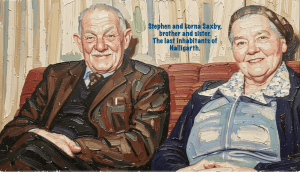
Whilst Dr Saxby’s daughter Ida married and moved to the Scottish mainland, Halligarth remained the home for his children Lorna and Stephen. Neither of these two married, and both died in 1994. The IPad impasto image of the cheerful pair here is created from a photograph from Stories and Pictures from Unst provided by Siân Loftus.
Thus Ida Sandison’s family (she died in 1982) inherited the Halligarth property. In 1998 the house and the walled garden were gifted by Ida’s family to the National Trust for Scotland NTS.
NTS has working partners, Unst Partnership Ltd and Shetland Amenity Trust, with a shared aim of securing the site for the future, and creating an amenity of benefit to the local folk and visitors. A project development officer with NTS Stewart Douglas has been in post since 2023, and a first phase of improvement is in place relating to the upkeep of the grounds, the woods and the cemetery. A structural survey was commissioned by NTS and presented to NTS in March 2026, A verbatim quote of the executive survey is presented below.
Structural Survey by Bolt Engineering 2nd March 202 – Executive Survey
This report provides a structural assessment of Halligarth House, a Category B listed 19th-century property in Unst, Shetland. Historically significant for its association with the Edmondston-Saxby family and its unique parallel-house layout, the building is currently in a state of advanced deterioration due to prolonged water ingress and harsh maritime exposure.
The assessment identifies a critical divide in structural integrity:
- Pre-1832 Structure: This remains the most resilient section; its masonry is largely sound, requiring only targeted repairs to specific timber floors and roof areas.
- 1836 and 1860 Structures: These sections are in poor condition. Widespread rot and woodworm infestation—driven by moisture levels measured up to 50%—have severely compromised all internal timbers.
- Immediate Risks: Rooms 0.3 and 0.9 pose an immediate risk to public safety due to their collapsed state. Additionally, a diagonal settlement crack exceeding 25mm in the 1860 extension requires urgent underpinning to prevent potential gable failure.
Further investigation is recommended to confirm the full repair scope; however, it is likely that all structural and non-structural timber in the 1836 and 1860 buildings will require replacement. Targeted repairs will be required to the rest of the structure. The latest entry in the Unst Partnership Ltd website relating to Halligarth is dated February 2026.
Unst Partnership AGM Feb 2026 – National Trust for Scotland (NTS) properties
Extract of Minute from Feb 2026:
We continue to liaise with NTS staff to improve visitor and residential facilities on Unst.
NTS appointed a Development manager in April 2023, Stewart Douglas, to oversee the work at Halligarth house and woods and to look at selling the other properties held by them on the island. Roselea, Houlland and the Laggans all went up for sale and were all either sold or under offer by the end of March 2025.
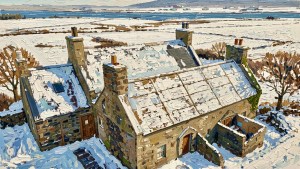
NTS continues to pay Unst Partnership for a grass-cutting contract in the area around the house, for which we engage a local contractor. Nothing as yet has come of the NTS plans to develop a “Citizen Science” visitor centre or any other visitor facilities in the grounds of Halligarth. It is now 27 years since the property and land was handed over to NTS.
Unst Partnership. Halligarth The Home of a Nuturalist
The following is a succinct statement of the partners project for Halligarth:
The proposed £1.2m project will renovate and restore Halligarth house to the highest of standards. Using a contemporary interpretation interior, the renovation will provide the UK’s most northerly islands with a visitor centre, resource library/learning centre, cafe, office space and outdoor picnic area. Accessibility to the house and woodland area is also going to be improved, with conservation at the forefront of planning.
Whilst developments, particularly in relation to provision of this large amount of funds are awaited, I give you some artistic images of Halligarth in its present state.
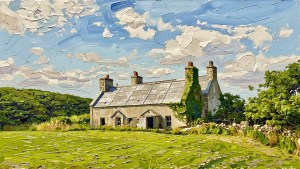

The following two pictures (depicting Halligarth by day and by night) have been created using a photograph of Dr Thomas and Maud Saxby’s second daughter Ida’s christening in 1900, which is held by the NTS. There is a family group in front of the house in the original. If you have Philip Snow’s book Tales from Wulver’s Hool you will see that there is a feature on the door which I have missed out. A white notice. Philip Snow explains that on the sign there is a welcome to ”Wir Ain”, our own, and “Da Fremmd”, which means stranger or outsider. The sign also indicates whether the doctor is at home or out on calls. A lantern is on at night.
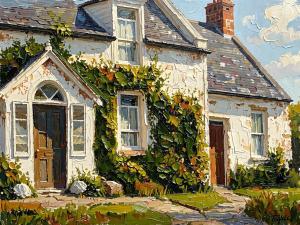
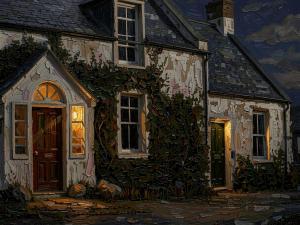
It is my hope and. I’m sure, the same is held by many, that some day soon Haligarth will, as a cultural centre, welcome in again “Wir Aim” and “Da Fremmd.”
George Ewen