
A blog by Hua Cui, Aspen freelance instructor.
Where Passion Meets Purpose: My Start in Mountain Rescue
A few years ago, somewhere between tying my boots for another Scottish hill day and drinking an excessive amount of coffee while studying a weather forecast that looked more like abstract art than useful information, a thought began to take hold: Could I give something back to the outdoor community? Not in a vague, well-intentioned way, but in a practical, meaningful, occasionally sleep-deprived way. That was when the idea of joining a Mountain Rescue team stopped being a passing notion and became something I genuinely wanted to pursue.
A Brief History of Scottish Mountain Rescue
Mountain Rescue in Scotland has a long and respected history. The first organised teams began forming in the mid twentieth century, largely driven by climbers and mountaineers who recognised that as more people ventured into remote and complex terrain, there needed to be a structured response when things went wrong.
Today, Scottish Mountain Rescue is a charity representing 26 volunteer teams across the country, supported by around 800 volunteers. These teams respond to roughly 600 callouts every year, ranging from overdue hillwalkers and navigation errors to serious injuries and complex multi-agency incidents in some of the harshest environments the UK has to offer. Every team member is a volunteer. There is no pay, no fanfare, and no guarantee of a full night’s sleep. What there is, however, is a shared commitment to helping others.
What Mountain Rescue Teams Are Looking For
One of the most common misconceptions about Mountain Rescue is that it is only for elite athletes or extreme mountaineers. Strong hill skills are essential, but they are only part of the picture. Teams look for well-rounded individuals who demonstrate solid navigation and planning skills, confidence operating in poor weather and winter conditions, physical resilience rather than outright speed, calm decision making under pressure, and, most importantly, the ability to work effectively as part of a team. Mountain Rescue is not about individual heroics. It is about collective competence.
The Selection Process: A Two-Way Assessment
The selection process reflects this philosophy. Rather than a single pass or fail event, prospective members attend training sessions over time. This allows the team to assess whether a candidate is a good fit, while also giving the candidate the opportunity to see how the team operates and understand the level of commitment involved. It is worth noting that not every year includes a selection day. Teams only recruit when numbers, experience levels, and team composition allow. When recruitment does happen, it is deliberate and carefully considered.

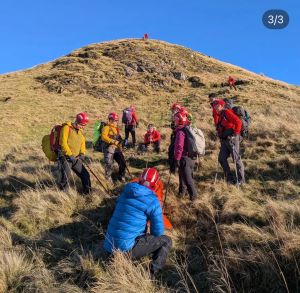
Selection Day: Sunshine, Of All Things
My final selection day arrived in November. Somewhat inconveniently, the weather was absolutely glorious. Blue skies, clear views, and sunshine from start to finish. Probably not what the team was hoping for. Ideally, selection days would involve horizontal rain, spindrift, and a healthy dose of Type Two fun to see how candidates perform when conditions are truly challenging. Instead, we had sunshine to endure, which felt mildly suspicious given the Scottish setting.
The morning consisted of three workshops. The first focused on winter hillwalking kit, covering what to carry, why it matters, and how small decisions can have serious consequences in cold environments. The second explored hill knowledge, including navigation, route planning, hazard awareness, and operating safely in winter conditions. The final workshop was with the leadership team and felt more like a conversation than an interview. It was an opportunity for them to understand my motivations, experience, and mindset, and equally for me to ask questions about the team, expectations, and the reality of the role. The afternoon was, in many ways, the most enjoyable part of the day. A proper hill day is designed to observe practical skills in context. Navigation, movement, communication, and judgment were all quietly assessed as we went. Candidates may also be asked to take on team-based tasks such as carrying equipment or working together to move a stretcher. Nothing dramatic, just a realistic insight into how teamwork functions during a callout.
The Waiting Game
Then came the hardest part. Waiting. There is something uniquely nerve-wracking about watching your inbox when the outcome matters and there is nothing left you can influence. When the email finally arrived later that day, and it was a yes, it felt less like success and more like being trusted with responsibility.
Tips for Prospective Applicants
If you are considering applying to Mountain Rescue, a few lessons stood out for me. Be honest about your experience; teams value integrity over bravado. Know your local hills properly in all seasons. Be open to learning and correction. Show that you can listen, adapt, and work with others. Attitude matters just as much as ability.
Just the Beginning
Selection is not the endpoint. It is the beginning. The following 12 months consist of an intensive training programme, with two evening sessions and one Sunday each month. Training covers casualty care, rope systems, search techniques, winter operations, and much more. Trainees must meet at least 80 per cent attendance to be accepted as full team members. It is a serious commitment, and rightly so. What this is for me is the privilege of helping others when they are at their most vulnerable, in places that many of us hold dear. It is a responsibility I will never take for granted. This is only the beginning of the journey, but it is one I am genuinely grateful to be on.