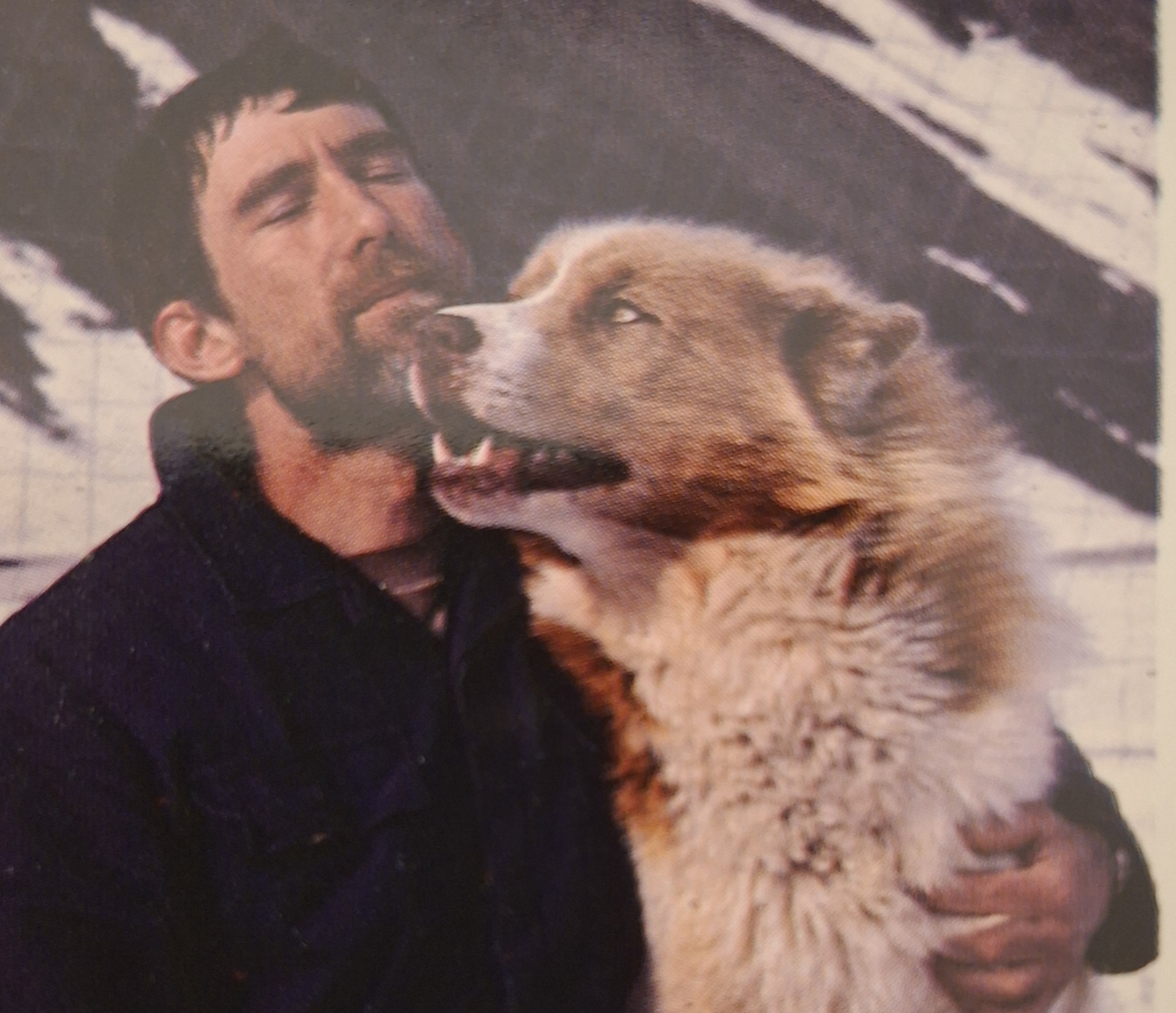
Few people have had a bigger impact on my life than Robin Buzza. Sadly Robin passed away in 2023, a father of five (Kara Maria, Isar, Sindre, Karin and Emily), an adventurer, businessman, writer and environmental campaigner. In this blog I’ll share my memories of him and what he meant to me. To read Robin’s obituary in Svalbardposten, click here.
Back in 1990 I was a 16 year old lad living in Aberdeen, in my last year of school. I was studious and a church-goer; I was a dedicated swimmer, lifeguard and swimming teacher; and, I had a dream to travel in the Arctic. Having grown up next to nature in Shetland and Orkney and fostered by my father’s curiosity for the world I longed for wilderness: to see expansive areas of snow and sea ice, to experience the midnight sun and to travel with huskies. I loved the outdoors and was desperate to climb Scotland’s hills but, aged 16, adventure mostly took the form of ever longer solo cycle trips in Aberdeenshire.
One day, looking at a copy of Scottish Field I saw an advert for a trek in Svalbard, with Arctic Wilderness Experience Ltd (Robin’s company). Few people knew where that was, but I did. I’d poured over maps of the Arctic and knew that Svalbard was a Norwegian archipelago in the high Arctic, just 550 miles from the north pole. About the size of Wales it had a population of 3,000, living in three towns: Longyearbyen, Pyramiden and Barentsburg. It was almost entirely glaciated, with alpine peaks and fjords; home to walrus, bearded seal, reindeer and polar bears. Could I go, I asked my parents. It was a lot of money and being the eldest, my parents had to consider being equally generous to my siblings when they reached young adulthood and asked for adventure. My parents agreed, the trek would be in August 1991.
In the half year prior to the trip, Robin would send letters, type written on yellow, lightly textured, weighted writing paper, providing information on what to bring, where to meet etc. I prepared for the trip with more solo cycles trips, the longest being a multi-day tour from Aberdeen to Knoydart to climb munros. Then there was a week of hillwalking at SU camp and that spring I saved up my lifeguard wages to buy a red, black and yellow Berghaus Gore-tex jacket.
August came around and it was time to leave. I travelled on my own through Norway then caught a flight north, from Tromso to Longyearbyen. Robin met me at the airport. He was tall with dark hair and a beard; a pipe hung from his mouth; he wore a cotton smock with a fur trim; and on his feet, he wore wellington boots.
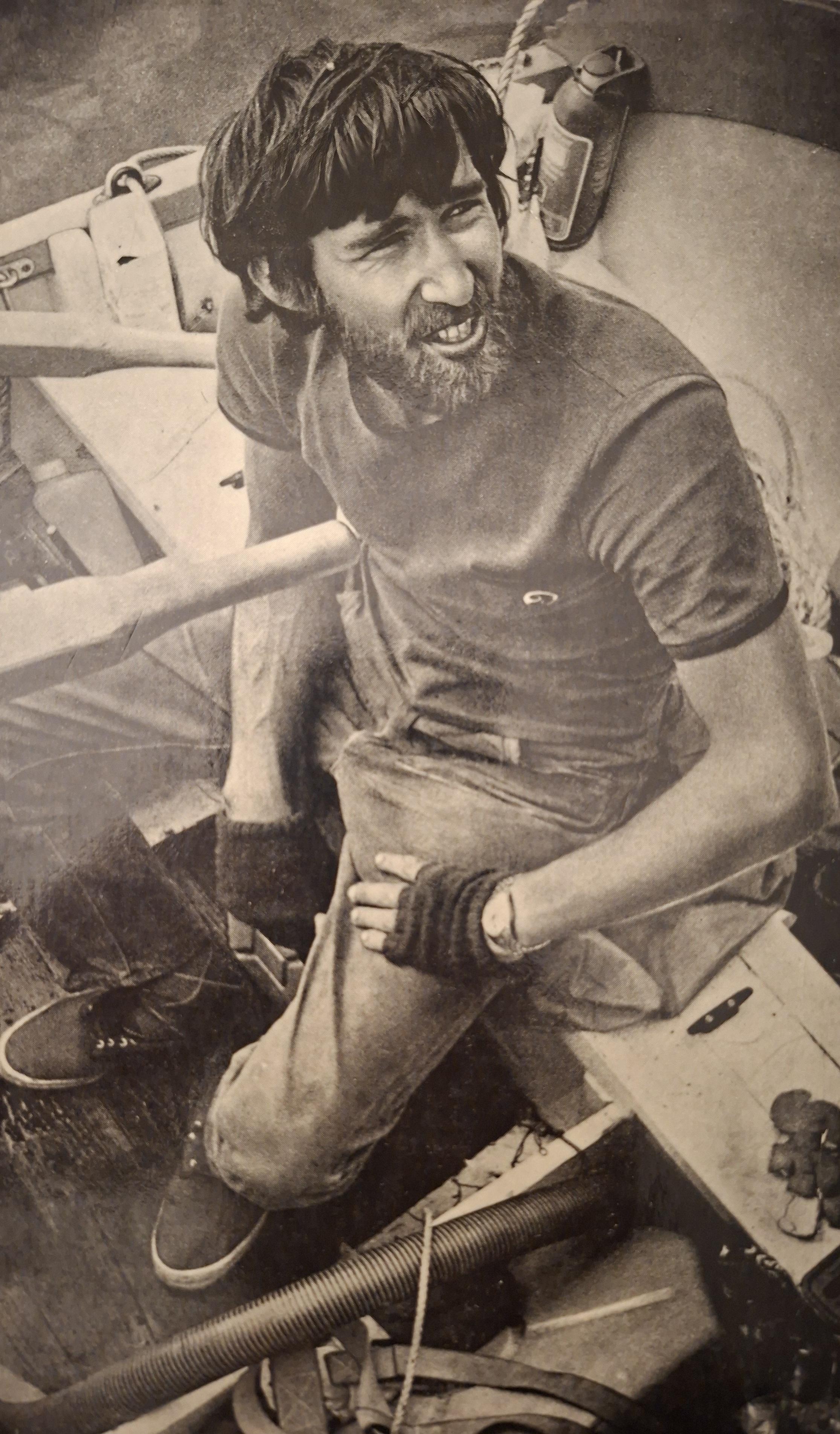

Robin was an Englishman, from Cheltenham. He was born in Africa to parents in the colonial service. Robin had spent five years in the military police as a young man, but was restless, unhappy with the prospect of a ‘normal life’ in England. He dreamt of wilderness, polar travel and adventure. He’d arrived in the north, in Tromso, in 1975, having rowed there solo, from Shetland. Then, with his girlfriend Torun, he moved to Svalbard, learnt Norwegian and built a life for himself there. When I met him he’d been living in Svalbard for 16 years. He’d built up a kennel of Greenland huskies and travelled by ski and dog sledge extensively. He’d learned about the hazards of polar travel, logistics, navigation, how to deal with polar bear encounters, endured freezing polar weather, survived dark winters, built a home and base at Bolterdalen, ten miles outside town, and developed a competence forged from years of hard travel and living. All this before establishing AWE Ltd, a business that ran dog sledging expeditions between the months of March and May. That summer, I was to learn, was the first time he’d run a summer trekking tour, and that summer, there was only one tour and I was its only client, a 17 year old boy from Aberdeen.


The timbre of his voice was authoritative, stable, serious and reserved. He spoke with calculated thoughtful pauses that communicated to me an expectation of competence. He held his body in a relaxed manner, utterly at ease in his wilderness garb with no pretensions. He asked direct short questions of me, and looked on with keen eyes, watching for signs that this boy was ready.
He drove me to a hostel in Longyearbyen and checked me in. The next day he picked me up, with two Greenland huskies, Bannoq and Tatra, and a hand gun (for polar bears)! We headed to the harbour where we boarded a boat that would take us across Isfjord to Pyramiden and Dicksonland, a large peninsula where we’d do our six day trek. I remember I was bit scared of him and fearful of messing things up, so didn’t communicate much. On the boat I noticed something green and rectangular floating in the water. I didn’t know what it was and didn’t mention it to Robin. It took a few hours to cross Isfjord and reach Pyramiden. Although Svalbard has Norwegian sovereignty, the citizens of 90 different countries; including Americans, Brits, Russian and Poles, have a right to live and work there. Long ago Longyearbyen had been established as an American coal mining town, and Pyramiden and Barentsburg were Soviet coal mining towns. There was a strategic imperative for the Russians to be there, and there still is today. The Barents Sea to the south was the only way the Soviet naval fleet at Murmansk could reach the Atlantic. The cold war very much played out in Svalbard. There were no roads between Svalbard’s towns. Access was limited to boats during the summer months and snowmobiles in the winter. Pyramiden was entirely Russian: there were statues of Lenin; and the road signs, cars, trucks, stores and schools were all Russian.

In Pyramiden I watched Robin searching for something. He looked concerned and he asked me if he’d seen his map case. “What did it look like? I asked, “It was green, rectangular” he replied. I shared with him that I may have seen it floating in the water back in Longyearbyen. Robin was annoyed, “Why didn’t you say? Didn’t you think to tell me?” he said scornfully. Feeling downcast I waiting at the harbour while Robin headed into Pyramiden to look for a map. Robin returned after an hour. He’d got a map, but it was a poor quality Russian one, with far less detail than the 1:100,000 scale Norwegian maps. Nonetheless, we began our trek, heading south, out of town: Robin, a man of vast experience, two huskies, and me!

The next six days with Robin were among the most impactful experiences of my life. On the first two days there wasn’t a breath of wind and air quality was unlike anything I’d experienced. I remember sitting on a hill with Robin late in the evening. The sun was low in the sky, casting long shadows (there’s 24 hours of daylight in Svalbard between mid April and the end of August). It was entirely silent and eerily still. The mountains around us looked startlingly close, sharp and vivid. It was like my brain had been stripped of any visual clues for depth perception. I later learned that this atmospheric phenomenon is called the ‘Clarity Effect’ arising when there are virtually no dust particles or moisture in the air to scatter light. I was in awe. Later I learnt that this captivating experience, to be in a state of awe, was what Robin’s company was all about: AWE ltd (and Arctic Wilderness Experience). I have no photographs of my own of that trip. I’d messed up loading the 35 mm film into my dad’s SLR camera. Robin kindly sent me prints, black and white stills. These images are special to me, because they were taken by him, scenes that caught his attention and resonated with him.


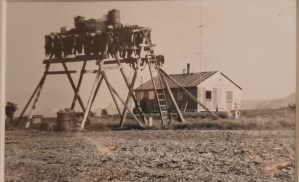
Later in the trip we visited a legendary hunter called Harald Solheim at his cabin at Kapp Wijk on the west coast of Dicksonland. Harald moved to Kapp Wijk in 1970 and lived there for 40 years, alone. He hunted Arctic fox and seal. I remember the seal carcasses hanging from a tall frame made of driftwood, suspended out of reach of polar bears. Robin and I stayed with him for two nights. Robin and Harald smoked and talked, about life in the Arctic and about their heroes, men like Fridtjof Nansen. I had my first beer there and we ate seal meat! In Harald’s small boat, laden with seal carcasses, we returned to Longyearbyen.
That September I started my undergraduate studies at Aberdeen University. I couldn’t shake the strong memory of my two week visit to Svalbard. I spent many hours in the basement of the library reading books about Nansen, Amundsen, Shackleton, Scott and Peary. I read about Sir Wally Herbert and his 1969 Trans Arctic dog sledge expedition across the Arctic Ocean. To me, Robin was cut from the same cloth as these men. He shared their resilience and immense internal drive. He eschewed modern means of polar travel favouring Nansen sledges and dog teams.
In Summer 1992 I travelled to Iceland for three weeks, then returned to my studies in Aberdeen. That winter, eager to return to Svalbard, I wrote to Robin and asked if I could work for him, during my university holidays. Robin replied and said yes. I would start in May 1993 as soon as my studies had finished and stay on til the end of August. My duties would include looking after the 30 Greenland huskies and guiding clients on treks. This four month period, and a subsequent summer in 1994, were life-changing for me.
Here’s an extract of a letter I wrote to my parents during that period.
12 August 1993
Dear Mum and Dad….
The weather the last couple of days has been really rough. Rain, sometimes sleet and really strong persistent wind. The kennels have, unfortunately got really muddy and that, with four bitches on heat, makes my daily work difficult and uncomfortable.
Two days ago the weather cleared. Having finished my work for the day I decided to head off into the mountains in the evening. My plan was to meet up with Robin. He’d been out on an expedition with clients and would, hopefully, be camping at Ayersbreen that night. I would bivvy out, and then climb those two big mountains I mentioned in my last letter.
It was a fantastic evening. After three hours of walking I found Robin’s camp, at 1:15 am. I then, because the weather was so fine, climbed the hills, with great success, getting back to the camp at 4:15 am. I slept til 8 am. It was a cold night.
I got a warm reception from Robin and his clients. There had been an injury. One of the clients, an English woman, had hurt her foot and could only walk very slowly, with assistance. It turned out that my chance visit to the camp was, in Robin’s words, “A Godsend”. I took some of the woman’s gear and the two grey dogs Robin had with him (Amok and Tuak) and headed to base to get the quad bike. I then headed back to meet Robin and the clients, driving over the riverbed. I met up with Robin and I gave the English women a lift to base. It had taken them four hours to do just two miles with that injury!
I got back to base having walked about 30 km with very little sleep over the last 36 hours. Nonetheless I had work to do with the dogs. I was busy til 11:30 pm. In gratitude for the rescue, Robin has promised to buy me a new pair of wellies. My pair have holes in them.
Love Alastair
Robin was a huge inspiration and I finished my time in Svalbard, in September 1994, with a very clear idea about what I wanted to do with my life. I wanted to share the experience of wilderness and nature with others. I felt particularly strongly that I wanted to help young people experience the physical and emotional benefits of outdoor adventures: experiencing a sense of awe and wonder, igniting curiosity, cultivating humility and strengthening communal bonds. My time with Robin set me on a path to becoming a mountain leader and to founding Aspen in 2016. This summer, with our two expeditions to Norway with young people, gave me a feeling of having come full circle.
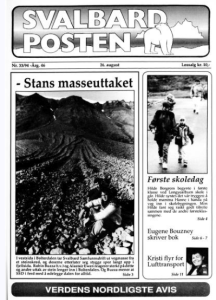
Robin felt it was vitally important to protect wilderness. During the time that I knew him, Robin organised a symposium called “Deep Ecology in the High Arctic. The Planetary Challenge: How do we Change Attitudes?“. The event was attended by the renowned Norwegian philosopher Arne Næss, who argued that all living things have inherent worth. Being around Robin and Arne had a big impact on me, prompting me to do my own campaigning, see newspaper front page below.
In closing, I want to add that Robin was someone who thought deeply about God and nature. On Robin’s book shelf in Bolterdalen were the complete works of Carl Jung. At the time I knew little of Jung but listened intently as Robin shared his philosophy and beliefs. Robin shared Jung’s insight that the divine and nature are fundamentally interwoven. Rejecting the idea that the psyche is merely a social construct, Jung maintained that our deepest bodily instincts and spiritual impulses are rooted in nature. I owe a great deal to Robin and had the greatest of respect for him.
POSTSCRIPT
Books by Robin:
Robin’s epic row across the North Sea and up the Norwegian coast is recounted in ‘Survive the Arctic Sea‘ (1978) published by the Shetland Times.
Another book by Robin is ‘Hvit Vilmark’ (1994), published by Grøndahl Dreyer. Hvitt Villmark means White Wilderness and is written in Norwegian.
Front page of Svalbardposten, August 1994,
Me and Robin on the cover. The headline translates ‘Stop the Mass Attack’. It’s about damage to Bolterdalen: the extraction of aggregate with bulldozers.