
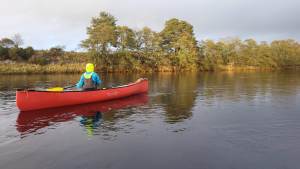
At the end of a very busy season, in late October, Penny and I headed north to Newtonmore, on a long-looked-forward-to multi-day canoe descent of the River Spey in Scotland. Over the course of four days, we endured cold temperatures and challenging rapids and delighted in otter sightings and hammock camps on beautiful islands. The experience was one of the best outdoor adventures I’ve ever had – a truly memorable, purposeful expedition to the sea that tested my skills and courage.
Late Friday night, I was fitting a new kneeling thwart in a canoe and packing all the kit I’d need: five days’ food, canoe repair kit, camp chair, emergency spare cloths (in the event of a capsize), tinder for campfires, and a hammock and tarp set up. Early Saturday morning, I drove north and met Penny in Newtonmore, our intended start point. From here, it is 80 miles of river paddling to the sea. Our first task was to lug our canoes and kit down to the riverbank, then drive our two vehicles and canoe trailer to Spey Bay. After 1 hour and 30 minutes, we reached the North Sea. It was wild. Fearfully, big waves crashed on the beach. Hopefully, it would be calmer on the river. Having left the van and trailer, we headed back to Newtonmore and got ready to start.
We put in at about 2:30 pm. Our objective for the day was to reach Loch Inch, about 10miles away. The river, at Newtonmore, was small but deep enough for good canoeing. I was a little hesitant at the start, eager not to make a mistake, capsize, and get cold. The main hazard in the upper reaches of the Spey is overhanging tree branches. The cold was a worry, too. There was snow on the mountains, and if we were to fall in, it would be very unpleasant. Many minor rapids (grade 1) over the next five miles helped us settle our nerves and get some practice in.
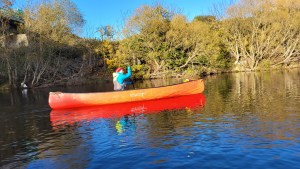


In the last few miles to Loch Inch, the Spey slows down and meanders. Large levees on the riverbank prevent flooding. Without much flow, our speed dropped to 3 miles an hour. At about 5 pm, we reached Loch Inch and found a lovely campsite. We planned to hammock camp, so every evening we’d need to find trees just the right distance apart to hang up our hammock and tarps. Hammock camping takes a bit more skill than tent camping, and can be more of a faff, until you get the hang of it. It was dark by the time we were happy with our setup… hammocks sufficiently tight, underquilts suspended, tarps taught, quick-release knots tied. A campfire and dinner warmed us up nicely.
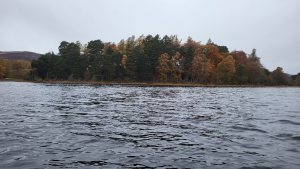
On Sunday morning, we managed to begin paddling at 7:30 am. To the north of Loch Inch, the river was bigger and the rapids a little more challenging. Penny took the lead and did a great job finding a safe line. The river flowed briskly, and it was a delight to move quickly and easily through the water. The main challenge was the cold. It rained most of the day, and our feet were numb most of the time. Despite this, we managed to do 2-3 hour stints of paddling at a time, before getting out, to eat, have a hot drink, and go for a jog to warm up. During one of our breaks, we had an otter sighting. We also saw Dippers, Ospreys, and lots and lots of Grey Herons. Our journey took us past Aviemore, Boat of Garten, and by mid-afternoon, we reached Granton-of-Spey. We decided to push on another 4 miles to reach an island campsite. Over the course of the expedition, islands proved to be fantastic places to camp, pleasantly isolated, wooded, spacious, and comfortable. We covered 27 miles!
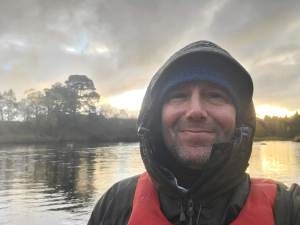
Monday – day 3 – was gonna be the most challenging day, in terms of rapids, with lots of grade 2s like the infamous ‘washing machine’ at Ballindaroch and the technical Knockando section. The river was faster again, and we covered the first 8 miles to Cragganmore quickly, at 5 miles an hour. At Cragganmore, the River Avon joins the Spey. Just beyond the confluence was our first big rapid, a wave train, formed as the river bends to the right. My line could have been better! I had intended to avoid the waves by being on river right, but I wasn’t ready and I was drawn into the main flow, taking on a little water from the crashing waves. Penny fared a lot better than me.
Next was the ‘washing machine’, another large wave train, created by a narrowing of the river. The correct line was to go right down the middle. We pulled up into an eddy, upstream of the rapid. We summoned up our courage and went for it. The waves felt big! Some strong stern prys helped me stay on course, remaining straight, and I bounced my way through. Pulling into an eddy, I looked upstream and watched Penny make her descent. She made it look easy! We remained dry, no swamping. Great fun!
Knockando was next. The Spey bends to the left and then to the right, in a big S shape. On the first bend, there was an island, and on the second, three islands, creating a complex set of rapids. Approaching the first bend, I made a last-minute decision to go river right. I found a nice line through the and came to a gentle stop in an eddy, a few feet away from a big otter, the second of our trip.
We decided to get out, inspect the river, and work out our line. The section ahead comprised two grade 2 rapids with an eddy in between. I headed off first. I lined up my canoe, aimed for a V shape in the flow, bumped down a drop, steered into an eddy, and waited for Penny. So far, so good. The next section required us to stay river right, avoiding a big wave that could capsize us. On I went, and with some strong draw strokes, I avoided the hazard and pulled into an eddy. Now it was Penny’s turn. Her line was slightly off, and her canoe turned sideways onto the wave. I looked on, fearing the worst, but amazingly, she bounced on through, sliding over the wave!
Safely through this section, our confidence grew. The rest of the day was great fun, with many more grade 2 rapids. We both felt like our skills were improving. The autumnal colours were fantastic, we moved swiftly and we relished every rapid. It was a great day. By 4 pm, we’d done 32 miles and arrived at another fantastic island campsite.
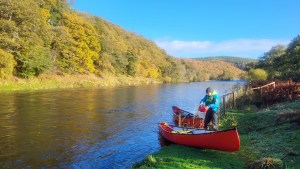

On Tuesday, day 4, the day began with heavy rain. We only had 8 miles to go to get to the sea. The river was really broad and powerful now. This last section had some serious hazards like large strainers, big boulders, and bridge piers, which absolutely had to be avoided. The consequences of making a mistake here felt serious. At this stage in our journey, however, we felt like we were paddling really well. It was satisfying being able to move around the river competently, finding the right line, and avoiding hazards. By 10 am, we were done. We had reached the tidal section of the river at Spey Bay. Right at the end we saw a big dog otter. Wonderful. The rain stopped, and we took our time getting the canoes organised and lingering on the beach, looking out across the North Sea and reflecting on what a fantastic journey we’d had.
Get in touch if you’d like to take part in a guided canoe adventure with Aspen!
